Friday, April 30, 2010

Cilantro Allergies

Cilantro comes from the leaves of the coriander plant and is often compared to parsley, sometimes it is even called Chinese parsley. Cilantro is native to Asia and Africa although it has been cultivated in

North America for many years. The herb is used in mainly Asian and tex-mex cooking or as a garnish. Cilantro when used as a herbal seasoning can be finely chopped making it hard for people with cilantro allergies to spot when mixed into a salad. It is also used in combination with several other herbs so it can also be difficult to detect which herb is causing your allergy symptoms.

Cilantro Allergy Symptoms

Vomiting

Tingling in mouth

Itching

Hives or skin rash

Upset stomach

Anaphylactic shock is rare

Tightness in throat or swelling

Allergy symptoms from cilantro usually occur in a matter of minutes after eating it, although rarely stomach and digestion problems can happen hours after consuming it.

If you have cilantro allergies dining out can be very difficult. Most restaurants will not list cilantro as a ingredient on their menu and its almost impossible to guess what dishes it will be used in. The best thing to do is ask your waiter or waitress to let the chef know you have a cilantro allergy.

Though the allergy is not as common as peanut and other food allergies they are growing. Whether this is do to the fact that more people are becoming allergic or because cilantro is being used in more and more dishes. If you think you may have a cilantro allergy the best thing you can do is see a doctor and get tested.

Thursday, April 29, 2010

Effaclar K - The Price to Pay

The rate in which people strive to achieve flawless skin and invisible pores simply amounts to a lucrative business for the acne cream companies. There are always those skin conscious individuals who are always searching for the best acne treatment they could. These people are expected to try a number of products before going to the last resort would be to consult their dermatologist who often recommends creams that just made a debut on the skin care market.

If the product the dermatologist recommended won't work, then these people will take matters into their own hands and then start grabbing acne creams that comes with eye-catching packagings over the grocery or the pharmacy. Some get lucky enough to get hold of good products such as the La Roche-Posay Effaclar K Acne Treatment Fluid.

Closer look on the product

Selling at roughly $20 per one ounce tube, this acne treatment ideally lasts for about 30 applications. Similar to other pimple fighting creams, it is applied in thin layers one to three times a day, depending on the severity of your acne. The most active cleansing agent of the cream is salicylic acid that works to deplete the excess oil produced on our faces and to unclog the pores from dirt. On the other hand, the presence of the micro beads assists in exfoliating the face from blackheads, whiteheads and dead skin cells.

The bargain

Beauty has a price. The red tag may be screaming at you once you see this tiny tube on the shelf, as compared to other brands that come with added skin care treatments, like lotions, toners and cleansers. It goes without saying that this one is kind of pricey. But before you place it back on its holder, this product, in spite of its brow-raising price, is surely a keeper; for there are still no negative statements about its efficacy in removing those blemishes from the pretty face of the ones who've already used it.

Good side

Nothing is ever cheap these days. By the time that you decide to sit down and finally sum up all the fees you've paid for your dermatologist to diagnose what's the problem with your skin, you have spent more than a $100.

Though it's going to break the bank with its price, it'll be gentle on your face. For while other acne creams are mainly composed of salicylic acids alone, this cream raised the bar above its competition by combining LHA and salicylic acid which in turn leads to better results.

Wednesday, April 28, 2010

Unconditional Love is God

Someone once told me that unconditional love is impossible for man. But is that true?

Yashua (Jesus) was the awesome man who practiced "unconditional love". When he hung on the cross in extreme pain, he prayed to his Father, "Father forgive them for they know not what they do." This is the ultimate in unconditional love. This is how he overcame evil on the cross. This is the whole armor of God!

But some of us seem to have a hard time even thinking the concept of "unconditional love". But there is a way we can get there in small steps, one little step at a time.

Every day, we can do a kindness for someone. It doesn't matter how big or small the kindness is. Each time we perform a kindness, it plants love in our hearts. This is a seed that begins to grow. And each time we do a kindness for someone, not expecting anything in return, we have moved one step closer to our heavenly Father. We have grown spiritually in a love that is the pure energy of God.

What an awesome walk we will have! There is no joy that compares to experiencing the pure love of God.

As God gathers His children home, which is what He is already doing, it is based on the love in our hearts. When we walk in His will, we will each be a member of His heavenly kingdom. It is this love in our hearts that unites us as one people. We will be invited to dwell in the New Jerusalem.

Is There a Need For Three Quarter Housing?

For recovering drug addicts and alcoholics, it's not just what's in a home that matters, but actually what isn't.

"Three Quarter Housing which is sometime referred to as Straight housing,", is critical for anyone trying to stay clean and sober. That means a place to live where any alcohol or drugs are strictly forbidden and, usually, where the other residents are also recovering substance abusers -- people who understand the trials of staying straight and support each other in the effort.

Such housing is at the end of a recovery chain that begins with detox and treatment centers, then, customarily, moves on to halfway houses. At each step along the way, facilities are in short supply. Millions of Americans in need of treatment aren't in the system or are stuck on waiting lists. But even for those who manage to get help, unless they are able to get the aftercare housing to reinforce what they learned in treatment, the failure rate is still too high.

In 2007, 23.2 million persons aged 12 or older needed treatment for an illicit drug or alcohol use problem. Of the 23.2 million, 3.9 million Americans (1.6 percent of the population) received some type of treatment for a problem related to the use of alcohol or illicit drugs. Of these, 1.4 million received treatment for the use of both alcohol and illicit drugs, 0.8 million received treatment for the use of illicit drugs but not alcohol and 1.3 million received treatment for the use of alcohol but not illicit drugs. Of the remainder, 28.5 percent reported that they made an effort to get treatment, according to the 2007 National Household Survey on Drug Abuse, the latest edition of the government's annual tally.

According to U. S. Department of SAMSHA, which stands for Substance Abuse and Mental Health Administration, no health care coverage and could not afford the cost was the number one reason for 35.9 million when asked why they did not receive treatment and another 6.9 percent cited they did not know where to go for treatment. Imagine how many of these clients could have been serviced at $400.00 per month, the average monthly rent a Three Quarter House charges, an affordable figure for 85 percent of them.

A disproportionate share of people with alcohol or drug problems end up homeless or incarcerated. One survey of homeless youths in Los Angeles found that 71 percent had an alcohol- or drug-abuse problem. The Office of National Drug Control Policy has estimated that 70 to 85 percent of inmates in state prisons need treatment for addiction. The National Council on Alcoholism and Drug Dependence advocates alternatives to incarcerating those with alcohol or drug dependencies -- but, says Council president Stacia Murphy, the reality of addiction is that "rich people go to the Betty Ford clinic and poor people go to jail."

Most treatment facilities and halfway houses are intended as short-term shelter, with 30- or 90-day limits. Straight housing has proven effective, however, if recovering abusers are allowed to stay long enough. An independent study has found that an individual who stays in an Three Quarter House for 15 months or more has an 80 percent chance of staying clean and sober.

Tuesday, April 27, 2010

The 401(k) Retirement Plan Market - Current Trends

401K plans have become the default retirement plan for Americans. Most companies have transitioned away from defined benefit pension plans to defined contribution 401K-type plans. Americans are now mostly on their own for their retirement. Are they ready for it? Are they saving enough? Do they know how to invest successfully? These are all very important questions. On top of needing to rely almost exclusively on their own 401K plan for retirement American are facing declining odds that Social Security will be solvent enough to be of much benefit for younger people. Medicare is on an even more dire path towards bankruptcy. Because of the future fiscal problems with social security and Medicare it is very likely that benefits will be going down and taxes will be going up. Young Americans will have to fund their own retirement through their 401K-type plans, can count less on social security, and need to budget a healthy amount of money for rising healthcare costs and perhaps long-term care costs or coverage. Many people have virtually all of their long-term savings in their 401K plan which seems good until you retire and start taking the money out. At that point every dollar you take out is taxed at the high ordinary income tax rates. Thus, if you are retired and you want to take $4,000 per month out of your 401K or IRA for living expenses, you really have to take out close to $6,000 per month (assuming you are at the 33% marginal tax rate) to get your living expense money and to pay the taxes on the withdrawal. It looks like a difficult future for many people.

So what is the answer? Americans need to begin saving more, spending less, and investing smarter if they are going to make ends meet in their older years. The 401K industry has been making moves to improve and to help increase the odds of a "successful" retirement for more people. 401K plans have been changing for the better over the past few years, and costs and expenses for these plans have been coming down. Investors also need to do a better job of getting educated about personal finance and managing their own investments in their 401K's and IRA's. Many investors don't participate at all in these plans. The smartest investment people can make is usually contributing to their 401K plan at least up to the amount their company is matching. Those investments produce an almost guaranteed and instant 50%+ return depending on the match amounts. Other investors participate in their 401K's but they make many of the common mistakes such as having all their money in cash, chasing performance, trying to time the market, not rebalancing, taking too much risk, etc. So what are the trends in the 401K marketplace today that may help investors have a better chance at a comfortable retirement?

Current trends in the 401(k) retirement plan market:

Simpler plans. Simpler plans (fewer investment choices) result in higher participation rates and better investment choices by most employees. "Make it simple" and "Just do it for me" are two key themes in designing plans today. Simpler plans result in higher participation rates and higher investment rates for employees.

Employer contributions into 401(k) plans are increasing. The most common type of company match is $.50 per $1.00 up to a specific percentage of pay (usually 6% of pay).

Automatic enrollment. This is growing fast and increases enrollment rates and plan success measures. Default contribution rates are typically 3%+ of salary initially.

Automatic contribution escalation. Employees elect to have their contributions increase automatically over time (to target rates of 6%-10% of salary). This also results in higher savings rates into the plan which most employees need to make.

Increased use of diversified "target-risk" and "target-date retirement" funds. These are "do-it-for me" portfolios where the asset allocation is done for you. They make it easy and simple to invest.

Diversified target-date retirement funds are being used as the default option for employees rather than a money market or stable value option. This also increases the number of employees that are investing closer to at "appropriate" portfolio and increases their odds of successful investing.

Plan "success" is increasingly being measured as the percentage of employees that are saving enough for a comfortable retirement rather than just the participation rate. This is the bottom line and what really matters. How many are saving enough to be able to retire with 75% of their retirement age income levels? If we start to measure this and report it to companies and participants it should result in better and more informed outcomes.

Increased employer/owner concern about retirement plan costs and expenses and fiduciary liability (funds, fees, compliance, diversification, plan design, etc.).

Increased desire and ability to provide investment education and advice to participants by advisors and providers thanks to The Pension Protection Act of 2006. Companies are interested in getting more investment advice and education in person rather than from written materials, online tools or phone resources.

Earlier access to the plans. 49% now offer immediate eligibility to new employees (rather than requiring 1 year of employment).

Decreased use of the company's own stock as an investment option or match (ever since the Enron collapse and now the Bear Stearns Collapse).

401(k) plans are definitely improving and moving in the right direction to help people increase their odds of retirement success. Investors need to step up and increase their savings rates and education levels as well.

Banks 42145 Ram Air Intake System

Banks 42145 Ram Air Intake System


gotoshop


Product Details


mfr: BANKS SP-DIESEL INTAKE


gotoshop

Monday, April 26, 2010

Vitamin K Rich Foods

People that are on blood thinning or anticoagulant drugs after a stroke or surgery should limit intake of Vitamin K rich foods. Because Vitamin K primarily promotes blood clotting, you should ask your doctor if you should eat more foods low in Vitamin K.

If you are looking to limit your daily of intake of Vitamin K rich foods, then you need to avoid various green and leafy vegetables. Here is a brief list of foods high in Vitamin K: broccoli, spinach, Swiss chard, turnip greens, mustard greens, kale, cabbage, or cauliflower. If those foods are not on your favorite foods list, then you are all the better.

The role of Vitamin K in coagulation or clotting of the blood was one of the first known functions. Physicians typically prescribe blood thinners and anticoagulant drugs to patients after surgeries and strokes. Due to lack of physical activity these patients are normally at high risk for clotting particularly in the legs. As mentioned, Vitamin K actually plays an integral role in the synthesis of several proteins that regulate both, coagulation and anti coagulation of our blood. Therefore, some of the anticoagulant drugs have been designed to inhibit or compete with Vitamin K.

Researchers are also looking at other side effects of drugs that inhibit vitamin K. As discussed earlier, Vitamin K has been shown to increase bone density in the elderly. Therefore elderly patients on anti-clotting drugs must also keep a watchful eye on their bone density.

Because of these dangers, people on anticoagulant drugs should see their doctors regularly. Initially, it is important that the patient is monitored so that the physician is able to determine the proper dosage. Patients also need to be monitored when the use of the drug is discontinued, because it takes time for the body to restore the normal clotting ability.

The term Vitamin K actually refers to not only one, but to a group of fat soluble vitamins that are essential for the synthesis and modification of certain proteins that are mostly required for proper blood clotting. In fact, the "K" is actually from the German word for coagulation, spelled "Koagulation". Vitamin K has also been shown to inhibit fungal growth, and some studies show that it helps maintain strong bones in the elderly.

There are two natural forms. The first being Vitamin K1 is also known as phlloquinone. Vitamin K2, or menaquinone, is normally produced by naturally occurring bacteria in the large intestines. In addition, there are three synthetic forms, designated K3, K4, and K5.

Because Vitamin K can be easily found in foods and is also naturally produced by bacteria that line the gastrointestinal tract, cases of Vitamin K deficiency are very rare. However, it does occur. If you bruise or bleed easy, you may be deficient.

Vitamin K is such an integral part of proper clotting that many of the popular manufactures of rodent poisons have taken advantage of this knowledge. Many of the poisons are simply Vitamin K antagonists that inhibit the recycling of Vitamin K in rodents. The rodents simply die from Vitamin K deficiency and bleed to death. Some of the antagonists are so effective, that a single feeding of the poison, can not only kill the rodent, but also cause bleeding in animals, like a cat or dog, that eat the dead rodent.

Our chief source of Vitamin K is actually the synthesis by the bacteria naturally occurring in our intestinal lining. Therefore, in humans it is very difficult to become deficient, even with a low intake of dietary vitamin K. However, we can become deficient if the vitamin does not make it from our digestive tract to our blood stream. A common cause of Vitamin K deficiency is liver disease.

The liver produces bile acids that are secreted into the small intestines where they play a critical role in absorption of lipids. These lipids are important because they are the vehicles by which Vitamin K is absorbed into our blood stream. Liver diseases that decrease the production of bile greatly reduce the absorption of Vitamin K, which lead to Vitamin K deficiency. No matter how much Vitamin K is produce in the gastrointestinal lining or ingested through diet, without proper bile production and lipid absorption, the body will become deficient. So that is one more good reason to take care of your liver.

Antibiotics, that are ingested to treat bacterial infections, not only kill harmful bacteria in our bodies, but also eliminate the good bacteria in our intestines that produce our Vitamin K. To help reestablish the bacteria in you intestines after a course of antibiotics, it is often recommended that you eat yogurt with active cultures. There are also probiotic supplements that are available at pharmacies and health food stores.

We are continually learning more about Vitamin K. Foods high in Vitamin K should be avoided by people taking blood thinners. Today, it is clear that Vitamin K is vital to our health. However, stay tuned as we continue to learn more and more about how exactly Vitamin K plays a role in our daily function and our long-term health.

Tonight's Main Event - K&N Cold Air Intakes vs AEM Cold Air Intakes

Welcome to the air intake battle royale, where we force K&N Intakes and AEM Intakes to fight to the death...or at least until we have a clear winner holding the title of "Best intake for your auto." At face value, there are some similarities between these two fighters--both pack incredible pipes with the testing and training an intake needs to be a champion. We suspect the subtle differences are where the fight will be won; expect neither to be knocked out but rather jabbed into a bloody, stumbling, slurred submission.

In the black, red and orange corner we have K&N, the taller, heavier, more established fighter of the two. Sure, they've been slugging it out with other contenders for more than 30 years, much like an aged and grizzled fighter like Evander Holyfield. But, unlike Holyfield, K&N is sharper than ever, still packs quite a wallop, has their ears intact, and nobody is begging them to quit for their own good. K&N's advantage comes from not only being the undisputed champion intake, but also from being the brand that practically invented the sport.

AEM struts in as the challenger; a slimmer, faster, younger fighter sporting flashy red and yellow trunks. Buoyed by newer technology and plenty of support in the sport compact realm, AEM's plan is to take the lumbering K&N with speed, quickness and quality punches. This challenger firmly believes they're ushering in a new era of intake performance, design and maintenance.

The bell rings, and the two intake brands dance toward each other. They come together, and K&N lands a nice two-punch combination to the nose and jaw, thanks to their intake tubes. Their crosslink material tubes, available on the vaunted FIPK 57 Series and 63 Series Air Charger intakes, keep the incoming volumes of air much cooler than the metal tubes used with every AEM. Not to mention the price--crosslink plastic tubing helps a kit cost less. But, AEM relies on its smooth footwork to land a stinging gut shot, thanks to the dressy look of their pipes, which are slightly nicer in terms of engine compartment looks even when pitted against K&N's 69 and 77 Series.

AEM also rallies to run K&N into the corner with Brute Force, their brawny truck and SUV intake that's gaining street cred by the minute. But, K&N escapes damage by striking AEM with their 69 series--an unlikely point on the card for the veteran. Though AEM has the sport compact high ground, most of the 69 Series is able to be configured as a short ram intake or a cold air intake drawing from the wheel well. Then K&N drills AEM in the eye with filter technology, setting off suffocating swelling. K&N's cotton-gauze with oil filtration system uses its time-tested formula and 1,000,000-mile warranty to land a big blow over AEM's struggling bid to equal cotton-gauze performance with an oil-less filter.

Round and round they go, trading jabs and the occasional slug that re-engages the crowd to this clash of now-tiring titans. As the 12th and final round passes with many a fist thrown but few landed, the judges must go to the scorecard. Though AEM takes rounds judged on compact performance and looks under the hood, K&N wins the battle by decision with an extra 4hp on the dyno for the F-150 with a 5.4L V8, which happened to be the judges' trucks. The cooler crosslink tube (which also costs less) helped put K&N over the top of AEM here, making it the current undisputed belt holder for intake performance. But, AEM will likely return soon with some new moves in its quest for the title.

Sunday, April 25, 2010

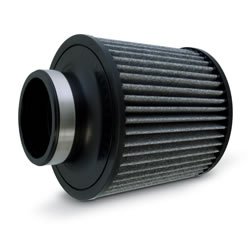
AEM 21-201DK 2.5" Inlet x 5" Element Dryflow Air Filter

AEM 21-201DK 2.5" Inlet x 5" Element Dryflow Air Filter


gotoshop


Product Details


Oil-Free Filtration - You never have to oil a Dryflow air filter, which provides many advantages over cotton-gauze. Not having to oil the filter reduces cleaning/servicing time from several hours to minutes, and eliminates the chance of oil migration up the inlet pipe. The reduced weight of the filter (because of a lack of oil and wire mesh) reduces stress on the inlet pipe and allows us to design the filter for unmatched durability. Easy to Clean - The Dryflow filter cleans in minutes using soap and water. It will dry in minutes and be ready for re-installation. At the track or on the trail, you can quickly clean the filter by removing and knocking it against your hand to release a majority of the dirt. Since oil is not used, the dirt will not cake to the media’s surface. Ultra Durable - The Dryflow filter has several durability advantages over oiled cotton-gauze and even competitor dry filters. The lightweight media is constructed of a non-woven polyester, which allows the Dryflow to take abuse and still perform and look like new. An internal nylon-reinforced cage (most conical filters) provides structural rigidity so the filter will never collapse, and the lightweight urethane base, lid and edge seal will never deteriorate. The end product is a lightweight filter that will last forever. We guarantee it for life. The Best Filtration - Dryflow delivers an Industry-Leading filtration efficiency of 99.52% cumulative filtration efficiency and filters out particles as small as one Micron in ISO 5011:2000 independent performance filtration testing using A-2 Fine Test Dust. While our competitors test using Coarse Dust, we have found that A-2 Fine Test Dust testing is the most accurate form of filtration testing for real-world conditions, since the harshest dirt to affect an engine is sub-two micron.


  • Never requires oiling during cleaning
  • Reduce cleaning time from hours to minutes
  • Bullet-proof construction
  • Up to 99.52% Filtration Efficiency as small as 1 Micron!
  • Element is cleanable and is guaranteed for the life of your vehicle


gotoshop